Quartz Countertops
Low-maintenance engineered quartz that resists stains and scratches and never needs sealing, in a wide range of colors and patterns.
Countertop Installation in Lakewood, CA
Call (562) 959-9173 Get a Free Estimate

Guidance on when a countertop is worth saving and when a fresh slab makes more sense for your budget.
A kitchen sink almost always wears out before the surface it sits in. The bowl blooms rust around the drain, the porcelain crazes and goes grey, the disposal flange starts weeping into the cabinet, or the household simply outgrows a shallow double bowl that will not take a roasting pan lying flat. Meanwhile the stone around it is in perfect condition, paid for, and nobody wants to hear that it has to come out.
So the question arrives, usually over the phone, usually phrased as a yes or no: can the sink be changed on its own? The honest answer is that it depends on four things, all of which can be established in about ten minutes with a tape measure and a flashlight, and none of which are matters of opinion.
Whether a standalone sink installation is realistic comes down to the opening that already exists, the material that opening was cut into, how the current bowl is carried underneath, and where the drain leaves the cabinet. Get those four answers before anybody quotes the job, because the cheap version and the version that costs more than a new counter look identical from above.
The thing people picture is a bowl being lifted out and another bowl dropping in. What is actually fixed is the hole. Stone can be removed and it cannot be added back, which means the existing cutout sets a floor on every dimension of whatever goes in next.
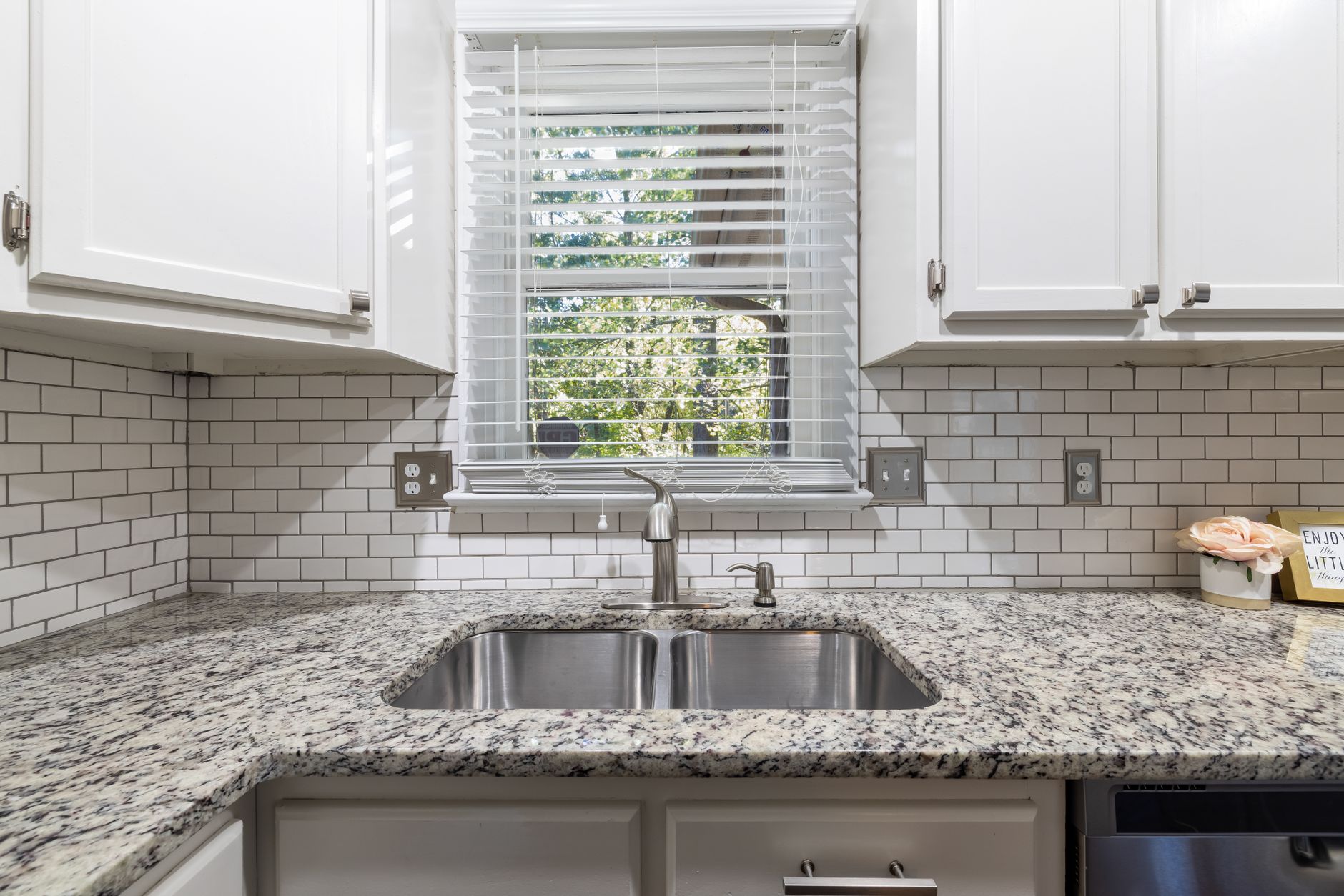
On an undermount installation the stone edge is the visible rim of the opening. The bowl hangs beneath it, and its flat top flange has to land on the underside of the stone all the way around with enough bearing surface to hold sealant. A replacement bowl whose opening is smaller than the existing cutout cannot do that. There is nothing to seal against at the ends, and the fix would be to make the hole smaller, which is not a thing anyone can do.
A replacement bowl that is slightly larger is usually workable. The stone then overhangs the bowl edge a little more than it did, which is a normal detail in its own right, and the reveal simply reads tighter. Push that too far and the counter starts hiding a visible strip of the basin and the corners look wrong, at which point the cutout has to be enlarged in place.
Measure the opening itself, corner to corner, not the sink you can see. Note the corner radius too. Old cutouts often have a tighter radius than current machines produce, and a bowl with a generous corner curve will not seat cleanly against a nearly square opening.
Replacing like for like, undermount for undermount or drop in for drop in, at the same outside dimensions, is a half day of work and it is the case worth hoping for.
The old bowl is disconnected, the sealant joint is cut, the clips are released, the bowl comes down into the cabinet, the underside of the stone is scraped and cleaned back to bare material, new anchors and clips go on, the new bowl is shimmed up tight to the stone, and the joint is resealed. The counter is never cut, never stressed, and never moved.
Two details decide whether it stays easy. Nominal sizes are not real sizes, so a sink sold as the same width as the old one can differ by a fraction of an inch in either direction and change the reveal from even to visibly uneven along the front. And the adhesive wants time. A bowl that is clipped, sealed and then filled with dishes the same evening is a bowl that will drop a hair over the next year and open the joint it was supposed to close.
This is the upgrade most people want, and it is the one that quietly turns into a fabrication job.
A drop in sink hides its cutout. The rim laps over the stone, so the opening underneath it was cut to the body of the bowl, not to any finished line, and the cut face inside it was very likely never polished because nobody was ever going to see it. Converting that to an undermount means enlarging the opening out to the bowl line, cutting a consistent radius at each corner, and then polishing the exposed inside face by hand to something close to the finish of the top surface.
All of that happens with the panel already installed, spanning cabinets, supported on its edges rather than sitting flat on a shop bed. Cutting a large opening into a stressed panel is how cracks start, and the piece most at risk is the narrow rail of material between the front of the sink and the front edge of the counter. The work can be done well. It is real risk on a top that currently has none, carried out in a lived in kitchen with water, slurry and a vacuum running.
There is also a hole problem nobody raises early. A drop in sink usually carries the faucet, the sprayer and the air gap on its own deck. Move to an undermount and every one of those has to be cored through the stone behind the bowl, on site, wet, next to an opening that has just been made bigger.
The reverse direction is the reliable escape hatch and it gets dismissed too quickly. A drop in rim covers a rough opening, an oversized opening, an unpolished cut face and a slightly out of round corner. If a stone top has a damaged or badly cut opening, or if the previous bowl was an odd size that nothing current matches, a drop in with a generous rim solves it in an afternoon.
The trade off is the raised lip that catches crumbs and a caulk line at the rim that eventually discolours. Those are real and they are not structural.
Granite and quartzite can be recut and repolished in place by someone who does it regularly, with the caveats above. Engineered quartz can too, though the polish on a field cut edge is harder to match because the factory finish came off a production line rather than a hand pad.
Laminate is a different animal. The cutout edge is particleboard or MDF that has only ever been protected by the sink rim sitting on it. Enlarging that opening exposes raw core to water and it has to be sealed properly rather than hopefully. A same size or larger drop in replacement is straightforward. An undermount conversion in post formed laminate is generally not worth attempting.
Solid surface is the most forgiving material here, because it is the same all the way through and can be cut, sanded and repolished in place to an invisible result. It is also the one material where a damaged integral bowl can sometimes be cut out and a new bowl seamed in.
Tile counters, which still turn up in original kitchens, bound the opening with trim pieces. Changing the sink size means retiling that section, and matching fifty year old glaze is usually impossible.
In the tract blocks that went up here in the early 1950s, a good number of original kitchens never had a cutout at all. They had a one piece porcelain enamelled steel sink with integral drainboards, dropped into a steel cabinet, where the sink and a large section of the work surface are the same stamped object. There is no separate counter to preserve, so the conversation changes entirely: replacing that sink means building a counter where one did not previously exist.
The other local pattern is plumbing. Most of these houses sit on a slab, so the waste line comes out of the wall rather than up through the floor. That matters the moment somebody chooses a deeper bowl. Going from a shallow older basin to a ten inch deep single bowl drops the tailpiece several inches, and the trap arm still has to run downhill to a stub out that has not moved. There is a depth at which the fall disappears, and finding it after the stone is cut is the worst possible time.
Add a disposal and the same problem gets tighter, because the unit’s outlet sits lower again and it takes up the space the trap needed.
Ask what the exact dimensions of the existing opening are, measured rather than assumed from the old sink’s model number. Ask whether the new bowl requires the opening to be enlarged, and if so, whether the cut face will be polished or left raw. Ask what is carrying the weight, because cast iron and fireclay bowls need a frame or a platform built into the cabinet rather than hanging from the surface. Ask who disconnects and reconnects the plumbing, and whether the trap arm has the fall it needs at the new bowl depth. Ask how long before the bowl can be loaded.
And ask the blunt one. Once cutting, polishing, coring and plumbing are added up, a sink swap on an existing top sometimes lands close to the price of a new surface. If the counter is something you would have replaced within a few years anyway, that is the moment to find out, not after the grinder is already running.

The most expensive countertop mistake is replacing one that only needed a repair. The second most expensive is pouring money into repeated fixes on a surface that is already done. Getting the repair-versus-replace call right saves Lakewood homeowners real money, so here is how we think it through on a kitchen off Woodruff Ave.
The surface you see sits on a substrate underneath, and the substrate is what decides everything. If the plywood or particleboard under a laminate counter has swelled from a leaky sink, no surface repair will hold, and replacement is the honest answer. But if the base is sound and only the top layer is damaged, you are almost always looking at a repair. We check this first on every visit near Candlewood St.
A surprising amount of counter damage is cosmetic and fixable. A chip in granite can be color-matched and filled. A loose or lifting seam can be re-bonded. A dull, water-marked stone surface just needs re-polishing and re-sealing to look new again. Small burn marks and shallow scratches on solid surface can be sanded out. For these, our countertop repair service is a fraction of the cost of a new slab and often finishes in one visit.
Some problems signal that a fresh surface is the better spend. Widespread cracking across a stone slab, laminate that is peeling at multiple edges, water damage that has reached the substrate, or a counter that has been repaired several times already all point to replacement. So does a kitchen remodel that changes the cabinet layout, since the old top will not fit the new footprint anyway.
If you are selling soon, a clean repair or a mid-range quartz or granite counter gives you the return buyers in the 90715 market notice without overspending. If this is your forever kitchen, it can make sense to jump straight to the quartzite or granite you actually want rather than repairing a surface you never loved. The right answer depends on your plans, not just the damage.
Photos and phone estimates only go so far. The honest recommendation comes from someone testing the substrate, checking the seams, and looking at the whole counter in person. That in-home look is free, and it turns a guess into a plan. If you would rather talk it through first, contact us and we will point you in the right direction.
Weighing a repair against a replacement in your Lakewood kitchen? Call Combattocorporate at (562) 959-9173 for a free in-home assessment.
One local crew for every popular countertop surface and every part of the job, from the first template to the last polished edge.
Low-maintenance engineered quartz that resists stains and scratches and never needs sealing, in a wide range of colors and patterns.
Natural granite brings one-of-a-kind character to a kitchen. We help you pick a slab in person and seal it to last for years.
Premium natural stone with dramatic veining for homeowners who want a showpiece counter, templated and sealed for lasting protection.
Warm wood butcher block and seamless solid surface for a softer, more forgiving look in kitchens and islands.
Seam repairs, chip and crack fills, re-sealing, and edge fixes that save a sound counter instead of replacing it.
Undermount and drop-in sink cutouts, a full range of edge profiles, and matching backsplashes cut and fit on site.
We install and repair countertops throughout Lakewood and the surrounding Los Angeles County communities, from the tract neighborhoods to the nearby cities.
Not sure if we reach your street? Call (562) 959-9173 and we will let you know.
Combattocorporate provides countertops installation in Lakewood, CA, working with granite, quartzite, quartz, marble, butcher block, solid surface, and laminate from the first measurement through the final polish. Whatever surface suits how you cook, we fabricate it and set it to fit your kitchen or bath exactly, with clean sink cutouts, the edge profile you choose, and a matching backsplash. Homes near Del Amo Blvd and the tract streets off Candlewood St get the same careful fit as any custom build.
Before we ever talk about a new slab, we help you decide whether you even need one. A counter with a single burn mark, a loose seam, or a chipped edge can often be repaired for a fraction of a full swap, and we will tell you honestly when that is the smarter call. Laminate that is peeling at the edge or a cracked tile counter, on the other hand, is usually money better spent on a fresh surface. That repair-versus-replace conversation happens first, on Woodruff Ave or anywhere else in the 90713 area, before any tear-out begins.
When a replacement does make sense, the styles worth considering come down to how the kitchen gets used. Busy families lean toward quartz for its no-seal durability, while cooks who want natural character pick granite or quartzite off a slab they picked in person. We walk you through the trade-offs of each material, show you real edge samples, and put a clear written number in your hand before we start. The price we quote off Bellflower Blvd is the price you pay.
Every slab we install is backed by a written warranty, and being a local Lakewood crew means we are still here if anything ever needs a second look. We template for the real conditions of your home, not the ideal ones, because older kitchens off South St rarely have square walls. We seal natural stone properly, finish every seam so it disappears, and protect your cabinets and floors while we work. A new counter is one of the first upgrades buyers in the 90715 market notice, and we think that is worth doing right the first time.
Countertop pricing depends mostly on the material and the size of your kitchen. Laminate is the most economical, engineered quartz and granite sit in the popular middle, and premium quartzite and marble run higher. A repair, when the counter is sound, costs a small fraction of any of these. Sink cutouts, edge upgrades, and backsplashes add to the total. The ranges below are typical for the Lakewood area, and we put the firm number in writing after a free in-home measure.
Ready to talk counters? We will measure your space, tell you honestly whether a repair or a replacement is the right move, walk you through materials and edges, and hand you a clear written estimate with no pressure. Most Lakewood installs are quick once the material is ready, and we handle everything from tearing out the old tops to the final polish.
Call (562) 959-9173